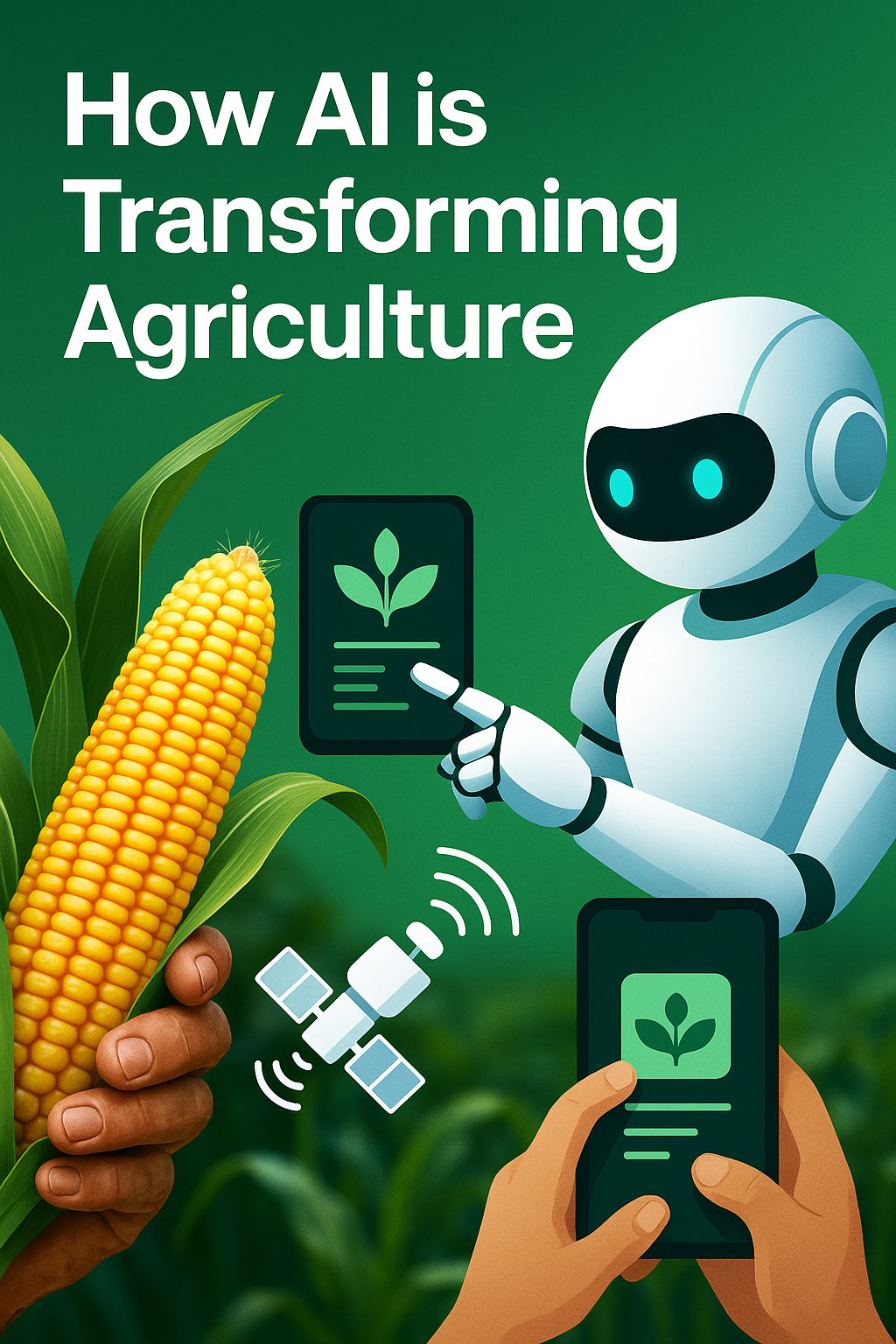
Agriculture remains central to Ghana’s livelihoods and food systems, employing a significant share of the workforce and contributing materially to GDP. That means agricultural productivity is not just an economic issue—it is a national resilience issue, tied to household income, food prices, rural stability, and climate risk. [1][2]
The problem is not a lack of effort; it’s the reality of constraints. Many smallholder farmers operate with limited access to timely weather signals, affordable agronomic guidance, pest and disease early warnings, and transparent market pricing. In that environment, AI is valuable only when it reduces uncertainty at the moment decisions are made: what to plant, when to plant, how to treat disease, and where to sell. [3]
One of the most mature AI applications in agriculture is remote sensing: machine-learning models that transform satellite imagery into actionable signals—vegetation stress, moisture proxies, and yield estimates. When paired with local ground truth and extension feedback, these tools can flag emerging issues earlier than field observation alone, enabling targeted interventions instead of blanket spraying or reactive responses. [3][4]
Pest and disease detection is another high-impact frontier. Image-based models can assist extension officers and lead farmers in identifying common leaf diseases, nutrient deficiencies, or pest damage, especially when integrated into mobile workflows. The value is not “perfect diagnosis”—it is faster triage, consistent guidance, and earlier escalation to experts when risk is high. [3][4]
Weather-smart decision support matters because timing is everything. AI-enhanced forecasts, combined with localized agronomy rules, can provide planting window guidance, irrigation planning, and harvest risk alerts. The key is localization: farmers need advice for their district and crop, not generic regional forecasts. Where data quality is limited, systems should communicate uncertainty clearly rather than overselling precision. [3]
Market intelligence is often overlooked. AI can reduce the information advantage of middlemen by summarizing price trends, demand patterns, and buyer locations across regions. Even simple predictive signals—like expected price movements around peak harvest—can help farmers choose whether to sell immediately or store, if storage is available. [3]
Finance is the hardest, but potentially transformative. Alternative-data models can help lenders understand seasonal risk and repayment capacity where formal credit histories are thin. Done responsibly, this can expand access to credit and insurance—but only with robust consumer protections, explainability, and guardrails against discrimination. [5]
None of this works without design for reality. Successful deployments typically blend AI with human systems: extension officers, farmer groups, cooperatives, and agribusinesses. Interfaces must match local usage: USSD where smartphones are not guaranteed, WhatsApp where it is dominant, voice support where literacy barriers exist, and multilingual options that reflect the communities served. [3]
Data governance is the quiet make-or-break factor. Farm data can reveal livelihoods and economic vulnerabilities. That means privacy, consent, security, and “who benefits” questions must be built into the product. Farmers should understand what data is collected, how it is used, and what value they receive in exchange. [6]
The takeaway is simple: AI in Ghanaian agriculture succeeds when it is humble and specific. Don’t sell “AI.” Sell outcomes: fewer crop losses, better input timing, earlier disease alerts, and improved market access. When AI becomes a reliable decision-support layer in the farmer’s daily routine, that’s transformation. [3]
References
[1] World Bank — Ghana: Employment in agriculture (% of total employment), indicator SL.AGR.EMPL.ZS: https://data.worldbank.org/indicator/SL.AGR.EMPL.ZS?locations=GH
[2] World Bank — Ghana: Agriculture, forestry, and fishing value added (% of GDP), indicator NV.AGR.TOTL.ZS: https://data.worldbank.org/indicator/NV.AGR.TOTL.ZS?locations=GH
[3] FAO — Digital technologies in agriculture and rural areas (guidance on advisory services, constraints, inclusion): https://www.fao.org/documents/card/en/c/cb8622en
[4] CGIAR — Digital innovation / AI-enabled advisory directions for smallholders (overview & evidence): https://www.cgiar.org/innovation/digital-innovation/
[5] World Bank — Data-driven finance / digital financial services (policy & risk considerations): https://www.worldbank.org/en/topic/fintech
[6] Ghana — Data Protection Act, 2012 (Act 843): https://lawsghana.com/post-legs-acts/data-protection-act-2012-act-843