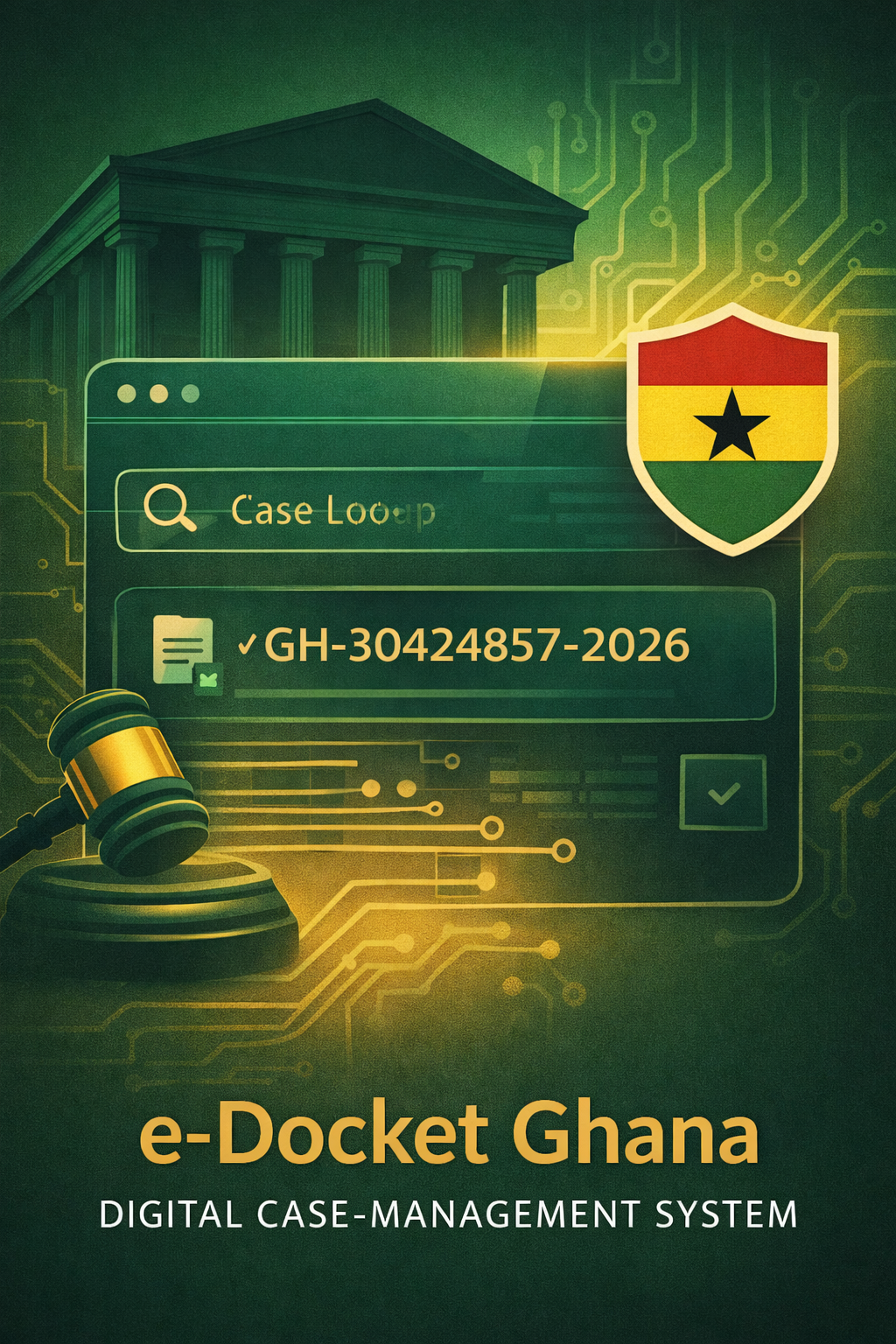
Justice systems earn public trust when they are predictable, accessible, and timely. Yet in many contexts, court processes still depend on paper movement, manual scheduling, and in-person follow-ups—creating avoidable delays for citizens, lawyers, and court staff. Digital case management is not a luxury; it is infrastructure for fairness and administrative discipline. [1][2]
Ghana already has meaningful digital foundations to build on, including judiciary-facing and citizen-facing online services. An “e-Docket Ghana” platform would consolidate and extend these capabilities into a coherent, end-to-end case lifecycle: filing → scheduling → hearing management → orders/judgments → archival. [3][4]
At the citizen-facing level, e-Docket Ghana should support case lookup by case number, party name, or lawyer reference, with clear hearing date visibility and automated reminders via SMS/WhatsApp/email. Reminders reduce missed hearings, cut uncertainty around adjournments, and eliminate unnecessary courthouse visits just to check “what’s happening.” When designed well, simple notification workflows deliver outsized efficiency gains. [1][2]
For legal professionals and court staff, e-filing must be secure, structured, and verifiable. That means: role-based access control, clear fee and submission workflows, and tamper-evident timestamping for filings. A modern portal should also enforce document completeness rules and metadata standards (case type, parties, counsel, filing category) so that retrieval becomes reliable, not dependent on “who remembers where the file is.” [1]
Archiving is where seriousness shows. Courts are long-memory institutions: records must remain accessible and authentic years later. That’s why PDF/A (the archival PDF standard) is widely used for long-term preservation—reducing the risk that future systems cannot open or verify records. e-Docket Ghana should store final versions in PDF/A where appropriate, alongside hashes and audit trails. [5][6]
A centralized repository for judgments and orders improves legal predictability and institutional memory. It reduces the “lost file” problem, speeds up precedent searches, and supports consistency in decision-making. Where public access is appropriate, published judgments should be anonymized with clear rules to protect sensitive identities. [1][2]
The admin dashboard is the operational control tower. Leadership needs backlog heatmaps, inflow/outflow trends, time-to-disposition metrics, adjournment rates, and SLA alerts to spot bottlenecks early. This is not surveillance—it’s operational accountability. Without measurement, delays become invisible, and invisible delays never get fixed. [1][2]
A public transparency portal can publish anonymized system metrics (clearance rates, median time-to-hearing, regional load distribution) and optionally expose a limited public API for civic monitoring—without compromising personal data. Public trust increases when institutions can show progress with verifiable indicators. [2]
Implementation should be phased. Start with a pilot cluster (one or two court divisions), digitize new cases first, and progressively backfill legacy cases based on priority. Pair the rollout with training, change management, and clear operating procedures. Courts succeed with digital tools when the process is redesigned around the tool—not when a tool is bolted onto the old paper workflow. [1][2]
With the right governance and security controls, e-Docket Ghana can reduce administrative friction dramatically: fewer in-person follow-ups, fewer missing files, clearer scheduling, and faster case progression. The goal is not “tech.” The goal is a justice system that citizens experience as timely, legible, and fair. [1][2]
References
[1] World Bank (GovTech/Justice) — Five ways digital technologies are transforming courts (case management, tracking, e-filing): https://blogs.worldbank.org/en/governance/five-ways-digital-technologies-are-transforming-courts-and-acces
[2] World Bank — Digitizing Court Systems: Benefits and Limitations (evidence & correlations with transparency): https://documents1.worldbank.org/curated/en/099825001082425972/pdf/IDU1f91ae60616eb614fd61866c1278bcc8c700e.pdf
[3] Ghana Judiciary — Official site and digital services entry points: https://www.judicial.gov.gh/
[4] Ghana Judiciary e-Justice / e-Services portal (service availability & guidance): https://www.judicial.gov.gh/index.php/e-services
[5] Library of Congress — PDF/A (archival PDF standard) overview and preservation rationale: https://www.loc.gov/preservation/digital/formats/fdd/fdd000318.shtml
[6] PDF Association — PDF/A (ISO 19005) primer: https://pdfa.org/resource/pdf-a/